YM/
ES
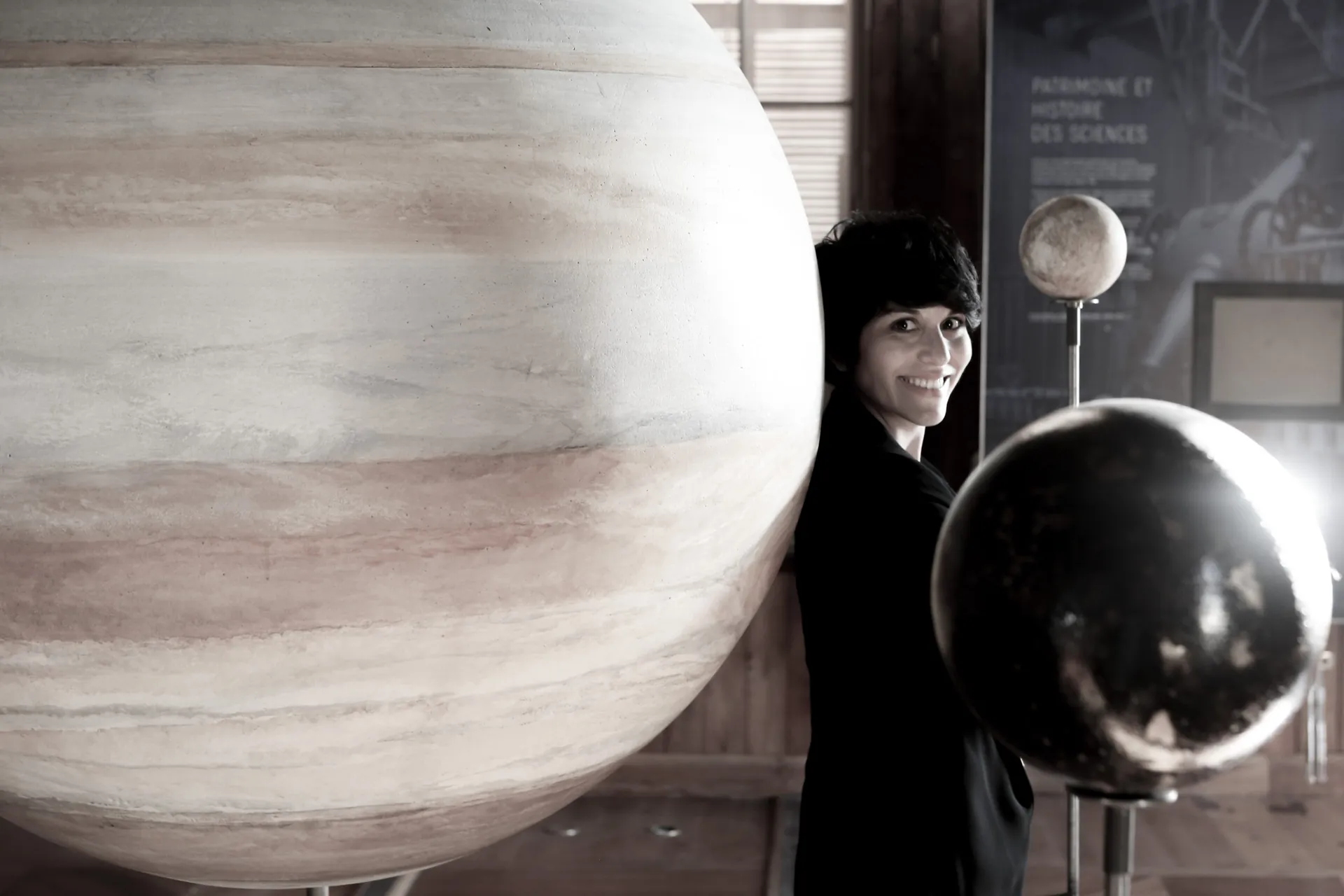
Yamila Miguel beside a model of Jupiter at the Old Observatory in Leiden

Yamila
Miguel

Associate Professor

Leiden Observatory
The Netherlands Institute for Space Research
Expertise
PLANETARY INTERIORS · ATMOSPHERES
Missions
NASA JUNO · ESA ARIEL · ESA PLATO · NASA MANTIS
Leading
ERC CONSOLIDATOR GRANT N-GINE · THE LEIDEN PLANETARY LAB
Recognition
NASA HONOR AWARD · PASTOOR SCHMEITS PRIZE · TEACHER OF THE YEAR
01 A little about me

I am an astrophysicist working to understand our place in the Universe. My research focuses on the atmospheres and interiors of both exoplanets and the planets within our Solar System.

I was born in Buenos Aires, Argentina, and knew early that I was going to be a scientist. I studied Astronomy at La Plata National University and completed my doctorate on the formation of planetary systems, supported by CONICET.

Postdoctoral years at the Max Planck Institute for Astronomy and the Observatoire de la Côte d’Azur took me from exoplanetary atmospheric chemistry to the interiors of giant planets, and brought me onto the Juno mission science team.

Since 2018 I have been at Leiden Observatory, and I am also affiliated with SRON, studying (exo)planetary atmospheres and interiors to understand how planets form and evolve. I am Principal Investigator of the ERC Consolidator grant N-GINE.

Jupiter's Great Red Spot photographed by the Juno spacecraft
02Research

UNVEILING THE SECRETS OF THE UNIVERSE

© JUNO

Research Interests: Exploring (Exo)Planet Interiors and Atmospheres

We have found more than 6000 planets around other stars, and almost none of them resemble anything in our Solar System. I work out what these planets are made of, their interiors and their atmospheres, and what that tells us about how planetary systems form. Jupiter and Saturn are the cases we can study closest, so they anchor everything else.

Invited Talks and Colloquia

My work has led to frequent invitations to present research at leading international institutes and conferences. Since becoming an independent researcher, I have delivered more than 50 invited colloquia at universities and research institutes worldwide, as well as more than 60 conference presentations, including more than 30 invited talks, keynote lectures and review presentations. These invitations reflect the international impact of my research.

I have presented invited colloquia at institutions including the Universities of Cambridge, Oxford, Exeter, St Andrews and UCL, and the Royal Observatory Edinburgh (UK); MIT, Princeton University, the University of Chicago, Carnegie Institution for Science, Harvard-Smithsonian Center for Astrophysics, UC Santa Cruz and NASA Goddard (USA); the Max Planck Institutes for Extraterrestrial Physics, Solar System Research and Astronomy, and University of Potsdam (Germany); KU Leuven (Belgium); ASIAA (Taiwan); and the Universities of Bern and Zurich and the Observatory of Geneva (Switzerland), among many others.

Upcoming in 2026

  • Invited talk at the Asia Oceania Geosciences Society (AOGS) meeting, August 2026.
  • Invited colloquium at the Observatory of Geneva, November 2026.
03 Refereed publications 110
2026 Sensitivity of dry lava planet atmospheric emission spectra to changes in lava compositions van Buchem, Christiaan P. A., Buddhacharya, Rojita, Zilinskas, Mantas et al. · Monthly Notices of the Royal Astronomical Society 2026 Coupled atmospHere Interior modeL Intercomparison (CHILI)—Protocol Version 1.0: A CUISINES Intercomparison Project of Magma Ocean Models Lichtenberg, Tim, Schaefer, Laura, Krissansen-Totton, Joshua et al. · The Planetary Science Journal 2026 The role of inner disk edges in shaping ultra-short-period planet systems around late M dwarfs Brandenberger, S. N., Sanchez, M., Van der Marel, N. et al. · Astronomy and Astrophysics 2026 Reassessing planetary composition: Evidence of rock-dominated envelopes in Uranus and Neptune Ramirez, Vanesa, Miguel, Yamila, Howard, Saburo · Astronomy and Astrophysics 2026 Investigating the High-energy Radiation Environment of Planets in Sun-like Binary Systems Behr, Patrick R., France, Kevin, Kruczek, Nicholas et al. · The Astronomical Journal 2026 Mean opacity tables for probing the interior and atmosphere of giant planets Siebenaler, Louis, Miguel, Yamila · Monthly Notices of the Royal Astronomical Society 2026 Hot and cloudy: high temperature clouds in super-Earths and sub-Neptunes Janssen, L. J., Miguel, Y., Min, M. et al. · Monthly Notices of the Royal Astronomical Society 2026 The MUSCLES Extension for Atmospheric Transmission Spectroscopy: Spectral Energy Distributions for 20 Exoplanet Host Stars that JWST Observed in Cycle 1 Wilson, David J., Youngblood, Allison, Duvvuri, Girish M. et al. · The Astronomical Journal 2026 Volcanic satellites tidally venting Na, K, and SO2 in optical and infrared light Oza, Apurva V., Gebek, Andrea, Meyer zu Westram, Moritz et al. · Monthly Notices of the Royal Astronomical Society 2026 Formation of cold giant planets around late M dwarfs via core accretion and the fate of inner rocky worlds Sanchez, M., van der Marel, N., Lambrechts, M. et al. · Astronomy and Astrophysics 2025 Possible Evidence for the Presence of Volatiles on the Warm Super-Earth TOI-270 b Coulombe, Louis-Philippe, Benneke, Björn, Krissansen-Totton, Joshua et al. · The Astronomical Journal 2025 Metal-enriched Atmospheres in Warm (Super- and Sub-) Neptunes Induced by Extreme Atmospheric Escape Louca, Amy J., Miguel, Yamila · The Astrophysical Journal 2025 Retrieving interior properties of hot Jupiters with Love numbers and atmospheric measurements van Dijk, E. A., Miguel, Y. · Monthly Notices of the Royal Astronomical Society 2025 The PLATO mission Rauer, Heike, Aerts, Conny, Cabrera, Juan et al. · Experimental Astronomy 2025 Escaping Helium and a Highly Muted Spectrum Suggest a Metal-enriched Atmosphere on Sub-Neptune GJ 3090 b from JWST Transit Spectroscopy Ahrer, Eva-Maria, Radica, Michael, Piaulet-Ghorayeb, Caroline et al. · The Astrophysical Journal 2025 Characterising the atmosphere of 55 Cancri e: 1D forward model grid for current and future JWST observations Zilinskas, M., van Buchem, C. P. A., Zieba, S. et al. · Astronomy and Astrophysics 2025 LavAtmos 2.0: Incorporating volatile species in vaporisation models van Buchem, C. P. A., Zilinskas, M., Miguel, Y. et al. · Astronomy and Astrophysics 2025 Super-Earths and Earth-like Exoplanets Lichtenberg, Tim, Miguel, Yamila · Treatise on Geochemistry 2025 The Mega-MUSCLES Treasury Survey: X-Ray to Infrared Spectral Energy Distributions of a Representative Sample of M Dwarfs Wilson, David J., Froning, Cynthia S., Duvvuri, Girish M. et al. · The Astrophysical Journal 2025 Conditions for radiative zones in the molecular hydrogen envelope of Jupiter and Saturn: The role of alkali metals Siebenaler, L., Miguel, Y., de Regt, S. et al. · Astronomy and Astrophysics 2024 Temporal variability in transmission spectra of H2-dominated exoplanets: The influence of thermal evolution and stellar irradiation on atmospheric composition Kecskeméthy, Viktória, Louca, Amy, Miguel, Yamila · New Astronomy 2024 The Featherweight Giant: Unraveling the Atmosphere of a 17 Myr Planet with JWST Thao, Pa Chia, Mann, Andrew W., Feinstein, Adina D. et al. · The Astronomical Journal 2024 Large Interferometer For Exoplanets (LIFE): XIV. Finding terrestrial protoplanets in the galactic neighborhood Cesario, Lorenzo, Lichtenberg, Tim, Alei, Eleonora et al. · Astronomy and Astrophysics 2024 JWST/NIRISS Reveals the Water-rich "Steam World" Atmosphere of GJ 9827 d Piaulet-Ghorayeb, Caroline, Benneke, Björn, Radica, Michael et al. · The Astrophysical Journal 2024 High-energy spectra of LTT 1445A and GJ 486 reveal flares and activity Diamond-Lowe, H., King, G. W., Youngblood, A. et al. · Astronomy and Astrophysics 2024 A secondary atmosphere on the rocky exoplanet 55 Cancri e Hu, Renyu, Bello-Arufe, Aaron, Zhang, Michael et al. · Nature 2024 Super-adiabatic temperature gradient at Jupiter's equatorial zone and implications for the water abundance Li, Cheng, Allison, Michael, Atreya, Sushil et al. · Icarus 2024 Sulfur dioxide in the mid-infrared transmission spectrum of WASP-39b Powell, Diana, Feinstein, Adina D., Lee, Elspeth K. H. et al. · Nature 2024 Martian paleolake outlet canyons - Evidence for controls on valley network formation Diamant, Sharon J. M., Bahia, Rickbir S., Sefton-Nash, Elliot et al. · Icarus 2023 A Neptune-mass exoplanet in close orbit around a very low-mass star challenges formation models Stefánsson, Guðmundur, Mahadevan, Suvrath, Miguel, Yamila et al. · Science 2023 Exploring the hypothesis of an inverted Z gradient inside Jupiter Howard, S., Guillot, T., Markham, S. et al. · Astronomy and Astrophysics 2023 Metallicity and Spectral Evolution of WASP 39b: The Limited Role of Hydrodynamic Escape Louca, Amy J., Miguel, Yamila, Kubyshkina, Daria · The Astrophysical Journal 2023 Using a neural network approach to accelerate disequilibrium chemistry calculations in exoplanet atmospheres Hendrix, Julius L. A. M., Louca, Amy J., Miguel, Yamila · Monthly Notices of the Royal Astronomical Society 2023 Exoplanet interior retrievals: core masses and metallicities from atmospheric abundances Bloot, S., Miguel, Y., Bazot, M. et al. · Monthly Notices of the Royal Astronomical Society 2023 LavAtmos: An open-source chemical equilibrium vaporization code for lava worlds van Buchem, Christiaan P. A., Miguel, Yamila, Zilinskas, Mantas et al. · Meteoritics and Planetary Science 2023 The MUSCLES Extension for Atmospheric Transmission Spectroscopy: UV and X-Ray Host-star Observations for JWST ERS & GTO Targets Behr, Patrick R., France, Kevin, Brown, Alexander et al. · The Astronomical Journal 2023 The energetic particle environment of a GJ 436 b-like planet Rodgers-Lee, D., Rimmer, P. B., Vidotto, A. A. et al. · Monthly Notices of the Royal Astronomical Society 2023 Retrieval Survey of Metals in Six Ultrahot Jupiters: Trends in Chemistry, Rain-out, Ionization, and Atmospheric Dynamics Gandhi, Siddharth, Kesseli, Aurora, Zhang, Yapeng et al. · The Astronomical Journal 2023 Photochemically produced SO2 in the atmosphere of WASP-39b Tsai, Shang-Min, Lee, Elspeth K. H., Powell, Diana et al. · Nature 2023 The impact of time-dependent stellar activity on exoplanet atmospheres Louca, Amy J., Miguel, Yamila, Tsai, Shang-Min et al. · Monthly Notices of the Royal Astronomical Society 2023 Jupiter's interior from Juno: Equation-of-state uncertainties and dilute core extent Howard, S., Guillot, T., Bazot, M. et al. · Astronomy and Astrophysics 2023 Observability of silicates in volatile atmospheres of super-Earths and sub-Neptunes. Exploring the edge of the evaporation desert Zilinskas, M., Miguel, Y., van Buchem, C. P. A. et al. · Astronomy and Astrophysics 2023 The Deep Atmospheric Composition of Jupiter from Thermochemical Calculations Based on Galileo and Juno Data Rensen, Frank, Miguel, Yamila, Zilinskas, Mantas et al. · Remote Sensing 2023 Early Release Science of the exoplanet WASP-39b with JWST NIRISS Feinstein, Adina D., Radica, Michael, Welbanks, Luis et al. · Nature 2023 Early Release Science of the exoplanet WASP-39b with JWST NIRSpec G395H Alderson, Lili, Wakeford, Hannah R., Alam, Munazza K. et al. · Nature 2023 Early Release Science of the exoplanet WASP-39b with JWST NIRSpec PRISM Rustamkulov, Z., Sing, D. K., Mukherjee, S. et al. · Nature 2023 Early Release Science of the exoplanet WASP-39b with JWST NIRCam Ahrer, Eva-Maria, Stevenson, Kevin B., Mansfield, Megan et al. · Nature 2023 Identification of carbon dioxide in an exoplanet atmosphere JWST Transiting Exoplanet Community Early Release Science Team, Ahrer, Eva-Maria, Alderson, Lili et al. · Nature 2023 Large Interferometer for Exoplanets: VIII. Where Is the Phosphine? Observing Exoplanetary PH3 with a Space-Based Mid-Infrared Nulling Interferometer Angerhausen, Daniel, Ottiger, Maurice, Dannert, Felix et al. · Astrobiology 2023 H2S and SO2 detectability in hot Jupiters. Sulphur species as indicators of metallicity and C/O ratio Polman, J., Waters, L. B. F. M., Min, M. et al. · Astronomy and Astrophysics 2023 Interior and Evolution of the Giant Planets Miguel, Yamila, Vazan, Allona · Remote Sensing 2022 Detecting life outside our solar system with a large high-contrast-imaging mission Snellen, Ignas A. G., Snik, F., Kenworthy, M. et al. · Experimental Astronomy 2022 Atmospheric characterization of terrestrial exoplanets in the mid-infrared: biosignatures, habitability, and diversity Quanz, Sascha P., Absil, Olivier, Benz, Willy et al. · Experimental Astronomy 2022 X-Ray Emission from the Exoplanet Hosting LTT 1445 Triple Star System Brown, Alexander, Froning, Cynthia S., Youngblood, Allison et al. · The Astronomical Journal 2022 Juno Spacecraft Measurements of Jupiter's Gravity Imply a Dilute Core Militzer, Burkhard, Hubbard, William B., Wahl, Sean et al. · The Planetary Science Journal 2022 K2 and Spitzer phase curves of the rocky ultra-short-period planet K2-141 b hint at a tenuous rock vapor atmosphere Zieba, S., Zilinskas, M., Kreidberg, L. et al. · Astronomy and Astrophysics 2022 Jupiter's Temperature Structure: A Reassessment of the Voyager Radio Occultation Measurements Gupta, Pranika, Atreya, Sushil K., Steffes, Paul G. et al. · The Planetary Science Journal 2022 Jupiter's inhomogeneous envelope Miguel, Y., Bazot, M., Guillot, T. et al. · Astronomy and Astrophysics 2022 Revelations on Jupiter's formation, evolution and interior: Challenges from Juno results Helled, Ravit, Stevenson, David J., Lunine, Jonathan I. et al. · Icarus 2022 Observability of evaporating lava worlds Zilinskas, M., van Buchem, C. P. A., Miguel, Y. et al. · Astronomy and Astrophysics 2022 Ariel planetary interiors White Paper Helled, Ravit, Werner, Stephanie, Dorn, Caroline et al. · Experimental Astronomy 2022 Chemical variation with altitude and longitude on exo-Neptunes: Predictions for Ariel phase-curve observations Moses, Julianne I., Tremblin, Pascal, Venot, Olivia et al. · Experimental Astronomy 2022 Exploring the link between star and planet formation with Ariel Turrini, Diego, Codella, Claudio, Danielski, Camilla et al. · Experimental Astronomy 2021 Ion-driven organic chemistry for Titan-like atmospheres: Implications for N-dominated super-Earth exoplanets Bourgalais, J., Carrasco, N., Miguel, Y. et al. · Astronomy and Astrophysics 2021 Reconstructing the Extreme Ultraviolet Emission of Cool Dwarfs Using Differential Emission Measure Polynomials Duvvuri, Girish M., Pineda, J. Sebastian, Berta-Thompson, Zachory K. et al. · The Astrophysical Journal 2021 The Mega-MUSCLES Spectral Energy Distribution of TRAPPIST-1 Wilson, David J., Froning, Cynthia S., Duvvuri, Girish M. et al. · The Astrophysical Journal 2021 Temperature inversions on hot super-Earths: the case of CN in nitrogen-rich atmospheres Zilinskas, Mantas, Miguel, Yamila, Lyu, Yipeng et al. · Monthly Notices of the Royal Astronomical Society 2020 Planet formation and disc mass dependence in a pebble-driven scenario for low-mass stars Dash, Spandan, Miguel, Yamila · Monthly Notices of the Royal Astronomical Society 2020 The High-energy Radiation Environment around a 10 Gyr M Dwarf: Habitable at Last? France, Kevin, Duvvuri, Girish, Egan, Hilary et al. · The Astronomical Journal 2020 The Relative Emission from Chromospheres and Coronae: Dependence on Spectral Type and Age Linsky, Jeffrey L., Wood, Brian E., Youngblood, Allison et al. · The Astrophysical Journal 2020 Inflation of migrated hot Jupiters Mol Lous, M., Miguel, Y. · Monthly Notices of the Royal Astronomical Society 2020 The Deep Composition of Uranus and Neptune from In Situ Exploration and Thermochemical Modeling Cavalié, Thibault, Venot, Olivia, Miguel, Yamila et al. · Space Science Reviews 2020 Atmospheric compositions and observability of nitrogen-dominated ultra-short-period super-Earths Zilinskas, Mantas, Miguel, Yamila, Mollière, Paul et al. · Monthly Notices of the Royal Astronomical Society 2020 Diverse outcomes of planet formation and composition around low-mass stars and brown dwarfs Miguel, Y., Cridland, A., Ormel, C. W. et al. · Monthly Notices of the Royal Astronomical Society 2019 Jupiter formed as a pebble pile around the N2 ice line Bosman, A. D., Cridland, A. J., Miguel, Y. · Astronomy and Astrophysics 2019 The exoplanet revolution Miguel, Yamila · Europhysics News 2019 A Hot Ultraviolet Flare on the M Dwarf Star GJ 674 Froning, Cynthia S., Kowalski, Adam, France, Kevin et al. · The Astrophysical Journal 2019 Observability of molecular species in a nitrogen dominated atmosphere for 55 Cancri e Miguel, Y. · Monthly Notices of the Royal Astronomical Society 2019 Saturn's Deep Atmospheric Flows Revealed by the Cassini Grand Finale Gravity Measurements Galanti, E., Kaspi, Y., Miguel, Y. et al. · Geophysical Research Letters 2018 Satellites form fast & late: a population synthesis for the Galilean moons Cilibrasi, M., Szulágyi, J., Mayer, L. et al. · Monthly Notices of the Royal Astronomical Society 2018 A chemical survey of exoplanets with ARIEL Tinetti, Giovanna, Drossart, Pierre, Eccleston, Paul et al. · Experimental Astronomy 2018 A better characterization of the chemical composition of exoplanets atmospheres with ARIEL Venot, Olivia, Drummond, Benjamin, Miguel, Yamila et al. · Experimental Astronomy 2018 The contribution of the ARIEL space mission to the study of planetary formation Turrini, D., Miguel, Y., Zingales, T. et al. · Experimental Astronomy 2018 The MUSCLES Treasury Survey. V. FUV Flares on Active and Inactive M Dwarfs Loyd, R. O. Parke, France, Kevin, Youngblood, Allison et al. · The Astrophysical Journal 2018 A suppression of differential rotation in Jupiter’s deep interior Guillot, T., Miguel, Y., Militzer, B. et al. · Nature 2018 Jupiter’s atmospheric jet streams extend thousands of kilometres deep Kaspi, Y., Galanti, E., Hubbard, W. B. et al. · Nature 2018 Measurement of Jupiter’s asymmetric gravity field Iess, L., Folkner, W. M., Durante, D. et al. · Nature 2017 Modeling Synthetic Spectra for Transiting Extrasolar Giant Planets: Detectability of H2S and PH3 with the James Webb Space Telescope Wang, Dong, Miguel, Yamila, Lunine, Jonathan · The Astrophysical Journal 2017 Cloud formation in metal-rich atmospheres of hot super-Earths like 55 Cnc e and CoRoT7b Mahapatra, G., Helling, Ch., Miguel, Y. · Monthly Notices of the Royal Astronomical Society 2017 The MUSCLES Treasury Survey. IV. Scaling Relations for Ultraviolet, Ca II K, and Energetic Particle Fluxes from M Dwarfs Youngblood, Allison, France, Kevin, Loyd, R. O. Parke et al. · The Astrophysical Journal 2017 The effect of differential rotation on Jupiter's low-degree even gravity moments Kaspi, Y., Guillot, T., Galanti, E. et al. · Geophysical Research Letters 2017 Jupiter's interior and deep atmosphere: The initial pole-to-pole passes with the Juno spacecraft Bolton, S. J., Adriani, A., Adumitroaie, V. et al. · Science 2017 Comparing Jupiter interior structure models to Juno gravity measurements and the role of a dilute core Wahl, S. M., Hubbard, W. B., Militzer, B. et al. · Geophysical Research Letters 2017 Thermodynamics, Disequilibrium, Evolution: Far-From-Equilibrium Geological and Chemical Considerations for Origin-Of-Life Research Barge, L. M., Branscomb, E., Brucato, J. R. et al. · Origins of Life and Evolution of the Biosphere 2017 Metal Enrichment Leads to Low Atmospheric C/O Ratios in Transiting Giant Exoplanets Espinoza, Néstor, Fortney, Jonathan J., Miguel, Yamila et al. · The Astrophysical Journal 2016 Jupiter internal structure: the effect of different equations of state Miguel, Y., Guillot, T., Fayon, L. · Astronomy and Astrophysics 2016 The Astrobiology Primer v2.0 Domagal-Goldman, Shawn D., Wright, Katherine E., Adamala, Katarzyna et al. · Astrobiology 2016 The MUSCLES Treasury Survey. II. Intrinsic LYα and Extreme Ultraviolet Spectra of K and M Dwarfs with Exoplanets* Youngblood, Allison, France, Kevin, Loyd, R. O. Parke et al. · The Astrophysical Journal 2016 The MUSCLES Treasury Survey. I. Motivation and Overview France, Kevin, Loyd, R. O. Parke, Youngblood, Allison et al. · The Astrophysical Journal 2016 A semi-analytical model for exploring Galilean satellites formation from a massive disk Miguel, Yamila, Ida, Shigeru · Icarus 2015 The effect of Lyman α radiation on mini-Neptune atmospheres around M stars: application to GJ 436b Miguel, Yamila, Kaltenegger, Lisa, Linsky, Jeffrey L. et al. · Monthly Notices of the Royal Astronomical Society 2014 Exploring Atmospheres of Hot Mini-Neptunes and Extrasolar Giant Planets Orbiting Different Stars with Application to HD 97658b, WASP-12b, CoRoT-2b, XO-1b, and HD 189733b Miguel, Y., Kaltenegger, L. · The Astrophysical Journal 2012 Rocky exoplanet characterization and atmospheres Kaltenegger, L., Miguel, Y., Rugheimer, S. · International Journal of Astrobiology 2011 Compositions of Hot Super-earth Atmospheres: Exploring Kepler Candidates Miguel, Y., Kaltenegger, L., Fegley, B. et al. · The Astrophysical Journal 2011 The diversity of planetary system architectures: contrasting theory with observations Miguel, Y., Guilera, O. M., Brunini, A. · Monthly Notices of the Royal Astronomical Society 2011 The role of the initial surface density profiles of the disc on giant planet formation: comparing with observations Miguel, Y., Guilera, O. M., Brunini, A. · Monthly Notices of the Royal Astronomical Society 2011 Un modelo determinista para la formación de sistemas planetarios Miguel, Yamila · Ph.D. Thesis 2010 Planet formation: statistics of spin rates and obliquities of extrasolar planets Miguel, Y., Brunini, A. · Monthly Notices of the Royal Astronomical Society 2009 Core instability models of giant planet accretion - II. Forming planetary systems Miguel, Y., Brunini, A. · Monthly Notices of the Royal Astronomical Society 2008 Core instability models of giant planet accretion and the planetary desert Miguel, Y., Brunini, A. · Monthly Notices of the Royal Astronomical Society
04

The Leiden Planetary Lab

The Leiden Planetary Lab group outdoors in Leiden
The group together on a summer outing
Group members at an escape room in Amsterdam
Group members at a conference beside the water

The Leiden Planetary Lab is the research team I lead at Leiden Observatory. We want to know how planets work: what they are made of, what their interiors and atmospheres are like, and what that tells us about their history.

Most of that understanding comes from a handful of measurements, so much of our work is interpreting observations and asking what they can, and cannot, tell us about a planet. We study worlds from the giants of our own Solar System to rocky planets orbiting other stars, and where our own Solar System fits among them.

Recent work led by the team

2026 Implications of a Stable Layer on the Vertical Structure of Jet Streams on Jupiter Keren Duer-Milner · Monthly Notices of the Royal Astronomical Society 2026 The deep atmosphere of Jupiter Keren Duer-Milner · Nature Communications 2026 Reassessing planetary composition: Evidence of rock-dominated envelopes in Uranus and Neptune Vanesa Ramirez · Astronomy and Astrophysics 2026 The role of inner disk edges in shaping ultra-short-period planet systems around late M dwarfs Saphira Brandenberger · Astronomy and Astrophysics 2026 Mean opacity tables for probing the interior and atmosphere of giant planets Louis Siebenaler · Monthly Notices of the Royal Astronomical Society 2026 Hot and cloudy: high temperature clouds in super-Earths and sub-Neptunes Leoni Janssen · Monthly Notices of the Royal Astronomical Society 2025 Detection and characterisation of a 106-day transiting Jupiter: TOI-2449 b/NGTS-36 b Solene Ulmer-Moll · Astronomy and Astrophysics 2025 From gas to ice giants: A unified mechanism for equatorial jets Keren Duer-Milner · Science Advances 2025 Presenting 28 years of Sun-as-a-star extreme ultraviolet light curves from SOHO EIT Emily Sandford · Astronomy and Astrophysics 2025 Retrieving interior properties of hot Jupiters with Love numbers and atmospheric measurements Esther van Dijk · Monthly Notices of the Royal Astronomical Society 2025 Conditions for radiative zones in the molecular hydrogen envelope of Jupiter and Saturn: The role of alkali metals Louis Siebenaler · Astronomy and Astrophysics
Yamila Miguel speaking on stage at TEDx Río de la Plata
05Science communication

PASSING ON THE KNOWLEDGE

Teaching: I developed the master’s course “Exoplanets A: Interiors and Atmospheres” at Leiden Observatory and have taught it ever since, and I previously taught “Stellar Structure and Evolution”. In 2024 I received Leiden University’s Teacher of the Year award. I see teaching as a challenge, and as one of the best ways I know to keep learning.

Yamila Miguel with her Stellar Structure and Evolution class of 2018

Stellar Structure & Evolution, Class of 2018

Outreach: One important part of my development as a scientist has been to stimulate interest and curiosity for science, sharing my research with the community and inspiring future scientists. I have presented more than 50 invited public colloquia and have been involved in numerous public activities since 2000. Some highlights:

2026
Mequation art-science collaboration.
Working with artist Thijs Biersteker, I developed the scientific model behind an interactive artwork that calculates the probability of a person’s existence. The installation premiered at SXSW London.
Leiden University feature.
2025
Interview for the Rockeando Ciencia podcast.
We discussed giant planets, the NASA Juno mission and the ESA Ariel mission.
Listen to the interview.
2025
NWA grant for Art-Science collaboration.
Working with artist Thijs Biersteker. Piece to be ready in October 2025.
Press release.
2024
Interview for New Scientist.
I discussed how knowledge of our Solar System can be connected with exoplanet research.
Read the interview.
2023
Participation in the makings of the musical “Women in Space”.
Jupiter character.
Trailer of the show.
2022
Science and Cocktails talk.
With 300 people, at Paradiso, Amsterdam.
Watch the talk on YouTube.
2021
Talk for the LWSK (amateur club).
2021
Talk for the amateur club “Euroster” of Rotterdam.
2020
Outreach talk on Characterisation of Exoplanets for the program “Universiteit van Nederland”.
Recorded in a TV studio in MediaPark Hilversum.
Watch it here.
2020
Public talk at the Pale Blue Dot Symposium.
Webpage.
2018
TEDx RiodelaPlata speaker.
With more than 2500 people(!), at Colón theatre, Buenos Aires, Argentina.
Watch it here (in Spanish).
2018
Member of the collaborators team of “Ciencia del Sur”.
A website for science outreach in Latin America.
Visit the site.
Yamila Miguel riding her road bike at golden hour
06Outside the lab

SWIM BIKE RUN

Doing Sports

I have been swimming since I was a kid, took up running fifteen years ago, and added cycling and bouldering along the way. The first three I combine into triathlons; bouldering I do for its own sake.

Why? Because doing sports is good! It is not only good for your health, but it also helps to release stress, to improve efficiency, and to have a fresher mind at work. It helps you solve problems.
On cold rainy days it can be hard to go outside and train. To keep myself in check on such days, I always set up a goal (often a competition I want to run), which besides being super fun, keeps my motivation high :)

07 You can find me @